
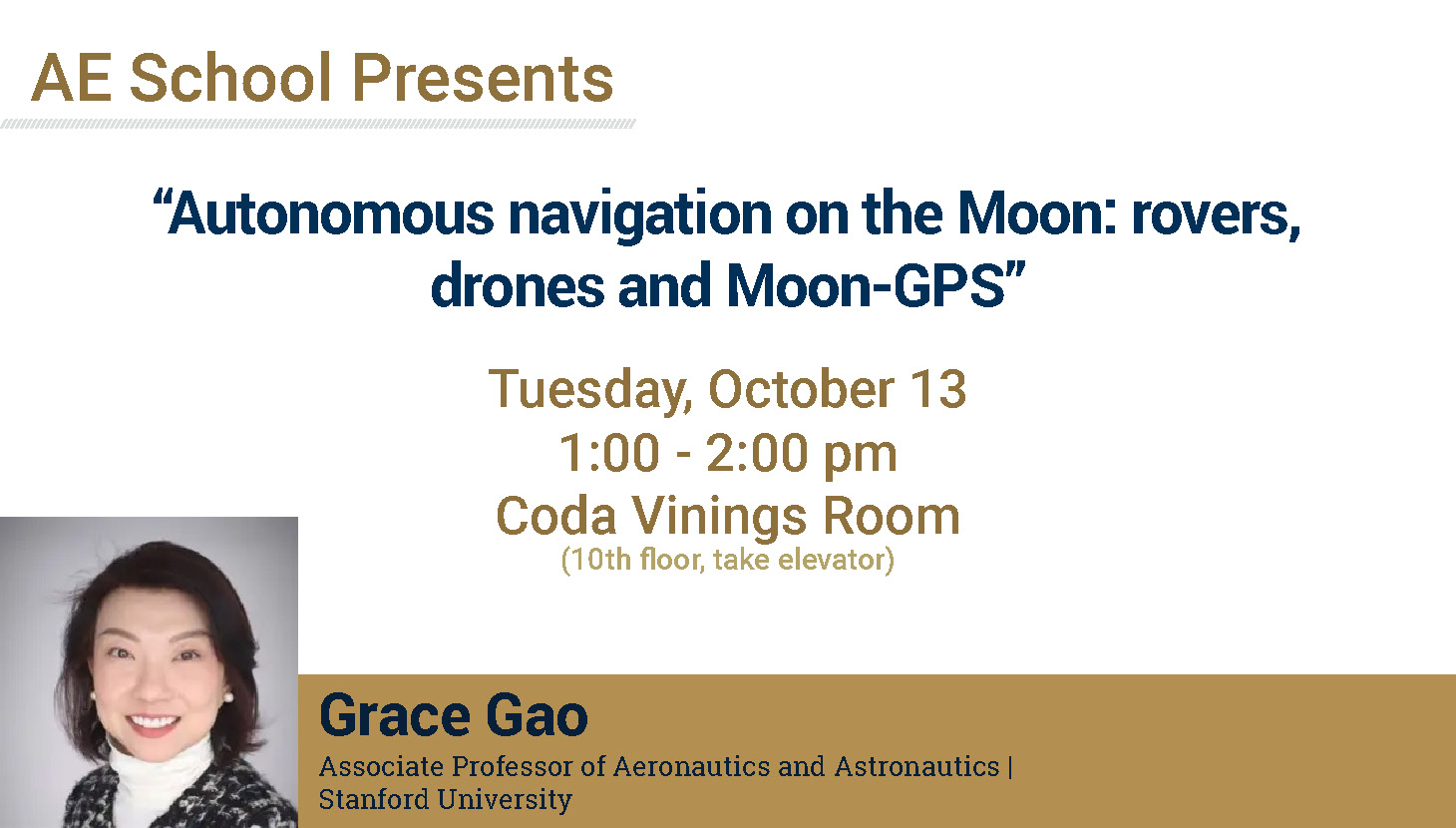
AE Seminar
"Autonomous navigation on the Moon: rovers, drones and Moon-GPS"
featuring
Grace Gao
(Associate Professor, Stanford University)
Tuesday, October 13
1:00 pm – 2:00 pm
Coda Vinings Room (10th floor, take elevator)
Abstract:
We are entering a new era of Moon exploration. After more than fifty years since the Apollo program, NASA's Artemis mission will land humans on the Moon again. Already on April 6, 2026, the Artemis II mission completed a historic crewed lunar flyby. In addition, NASA announced their Moon Base plan earlier this year, a multi-billion-dollar initiative to establish a permanent human outpost near the lunar South Pole.
In this talk, I will present our recent research effort on a "Moon-GPS," a lunar satellite navigation system with smaller and lower-cost satellites than the Earth-GPS satellites. I will present our recent learning and model-based research effort on autonomous navigation on the Moon. Our work provides tools for NASA’s Cooperative Autonomous Distributed Robotic Exploration (CADRE) project to send a swarm of small rovers to the moon surface; the Endurance Mission concept for a long-range traverse and sample return rover to drive about 2000km autonomously in the lunar South Pole–Aitken basin and the MoonFall mission designed to scout and map potential landing sites near the lunar South Pole ahead of future human Artemis missions using propulsive "hopping" drones.
Bio:
Grace X. Gao is an associate professor in the Department of Aeronautics and Astronautics at Stanford University. She leads the Navigation and Autonomous Vehicles Laboratory (NAV Lab). Prof. Gao has won a number of awards, including the National Science Foundation CAREER Award, the Institute of Navigation Early Achievement Award and the RTCA William E. Jackson Award. Prof. Gao also won various teaching and advising awards, including AIAA Stanford Chapter Excellence in Advising and Excellence in Teaching Awards.