
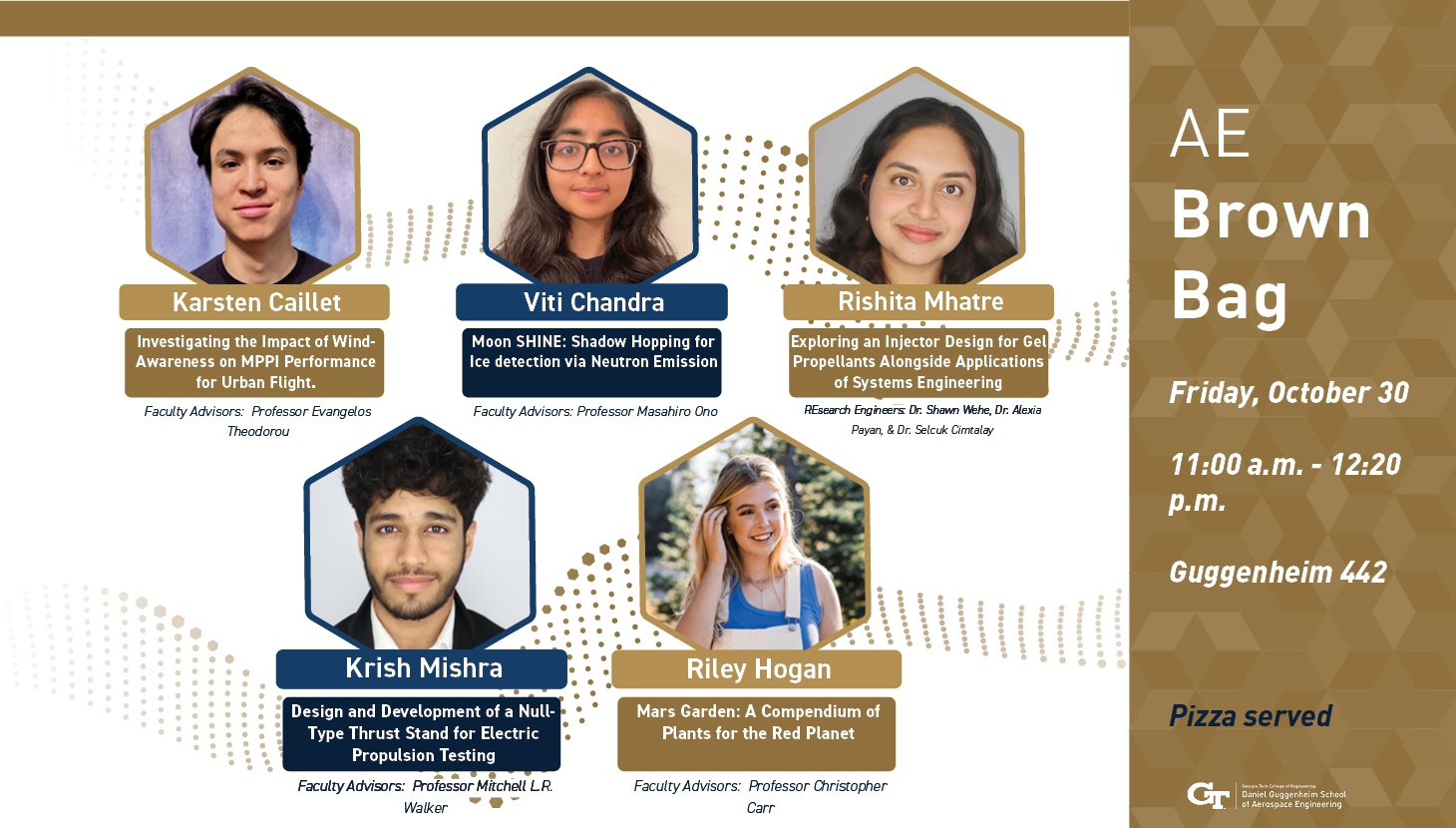
featuring
Karsten Caillet
Viti Chandra
Rishita Mhatre
Krish Mishra
Riley Hogan
Friday, October 30
11:00 a.m. - 12:20 p.m.
Guggenheim 442
Pizza Served
Rishita Mhatre
Title:
Exploring an Injector Design for Gel Propellants Alongside Applications of Systems Engineering
Abstract:
This presentation delves into two distinct areas of aerospace engineering. First, the use of gel propellants is explored, with particular emphasis on an injector design intended to mitigate the inherent challenges associated with gel propellant atomization. Second, the application of systems engineering principles in architecting solutions is examined through the lens of rotorcraft simulators and model-based systems engineering (MBSE). Collectively, these projects highlight a diverse set of undergraduate aerospace research experiences and emphasize key methods, tools, and lessons learned.
Research Engineers:
Dr. Shawn Wehe, Dr. Alexia Payan, & Dr. Selcuk Cimtalay
Riley Hogan
Title:
Mars Garden: A Compendium of Plants for the Red Planet
Abstract:
Mars Garden is a compendium of plant species selected for their potential to support sustainable human habitation on Mars. The project explores how plants can be integrated into a cohesive, mutually beneficial ecosystem within a controlled Martian environment. Rather than evaluating species individually, Mars Garden emphasizes plant compatibility, considering complementary growth requirements, nutrient cycling, resource efficiency, and ecological interactions. Species are assessed for their potential contributions to food production, oxygen generation, carbon dioxide removal, water conservation, soil development, and psychological well-being. By examining how different plants can work together to fulfill multiple life-support functions, the project aims to identify combinations that maximize productivity while minimizing resource consumption and waste. The resulting compendium provides a foundation for designing resilient, self-sustaining plant communities that could support future human settlements on Mars. Ultimately, Mars Garden envisions plants not simply as a source of food, but as essential components of an integrated biological life-support system that helps make long-term human habitation beyond Earth possible.
Faculty Advisors:
Professor Christopher Carr
Viti Chandra
Title:
Moon SHINE: Shadow Hopping for Ice detection via Neutron Emission
Abstract:
Moon SHINE (Shadow Hopping for Ice detection via Neutron Emission) proposes a new paradigm for lunar resource prospecting via a fleet of low-cost, autonomous CubeSat-scale hoppers collecting measurements in parallel. The Moon SHINE robot is based on a proposed 4U, 4kg platform developed at Georgia Tech with Arizona State University with four enclosed mechanisms enabling steerable hops without propellant or exposed moving parts. The research explores a trade space of employable hopping mechanisms as the team moves towards prototyping for the end of the semester, with the goal of innovating lunar exploration through Moon SHINE’s scalability.
Faculty Advisors:
Professor Masahiro Ono
Karsten Caillet
Title:
Investigating the Impact of Wind-Awareness on MPPI Performance for Urban Flight.
Abstract:
Urban wind fields pose a significant challenge to autonomous aircraft navigating near buildings, where gusts and spatial variations in airflow can compromise flight accuracy and safety. This research investigates how the quality and extent of available wind information affect Model Predictive Path Integral (MPPI) control for autonomous vertical takeoff and landing aircraft. Using NASA’s Generic Urban Air Mobility (GUAM) simulation framework and Lift+Cruise vehicle model, we compare controller performance across different levels of wind information, ranging from no wind awareness to increasingly accurate and spatially detailed wind estimates. Matched Monte Carlo experiments evaluate waypoint completion, trajectory deviation, obstacle clearance, and control effort. Improved wind information is expected to enhance navigation accuracy and robustness by enabling the controller to anticipate aerodynamic disturbances. This work aims to quantify the benefits of wind awareness and identify the information needed to support reliable autonomous urban flight.
Faculty Advisors:
Professor Evangelos Theodorou
Krish Mishra
Title:
Design and Development of a Null-Type Thrust Stand for Electric Propulsion Testing
Astract:
A null-type inverted pendulum thrust stand is being developed under an international contract through Georgia Tech for high-power electric propulsion testing under vacuum. Based on the NASA-457M thrust stand architecture, the system is designed to measure thrust from 0.5 to 350 mN while supporting heavy thrusters. Flexures permit small angular displacements, while a displacement differential sensor and electromagnetic actuator provide feedback control to hold the stand at its reference position. The measurement system combines displacement sensing with a pulley-based calibration mechanism and data acquisition for thrust measurements. The mechanical design includes a cooling system, leveling mechanism, propellant feeds, and more to support operations within a vacuum chamber.
Faculty Advisors:
Professor Mitchell L.R. Walker