
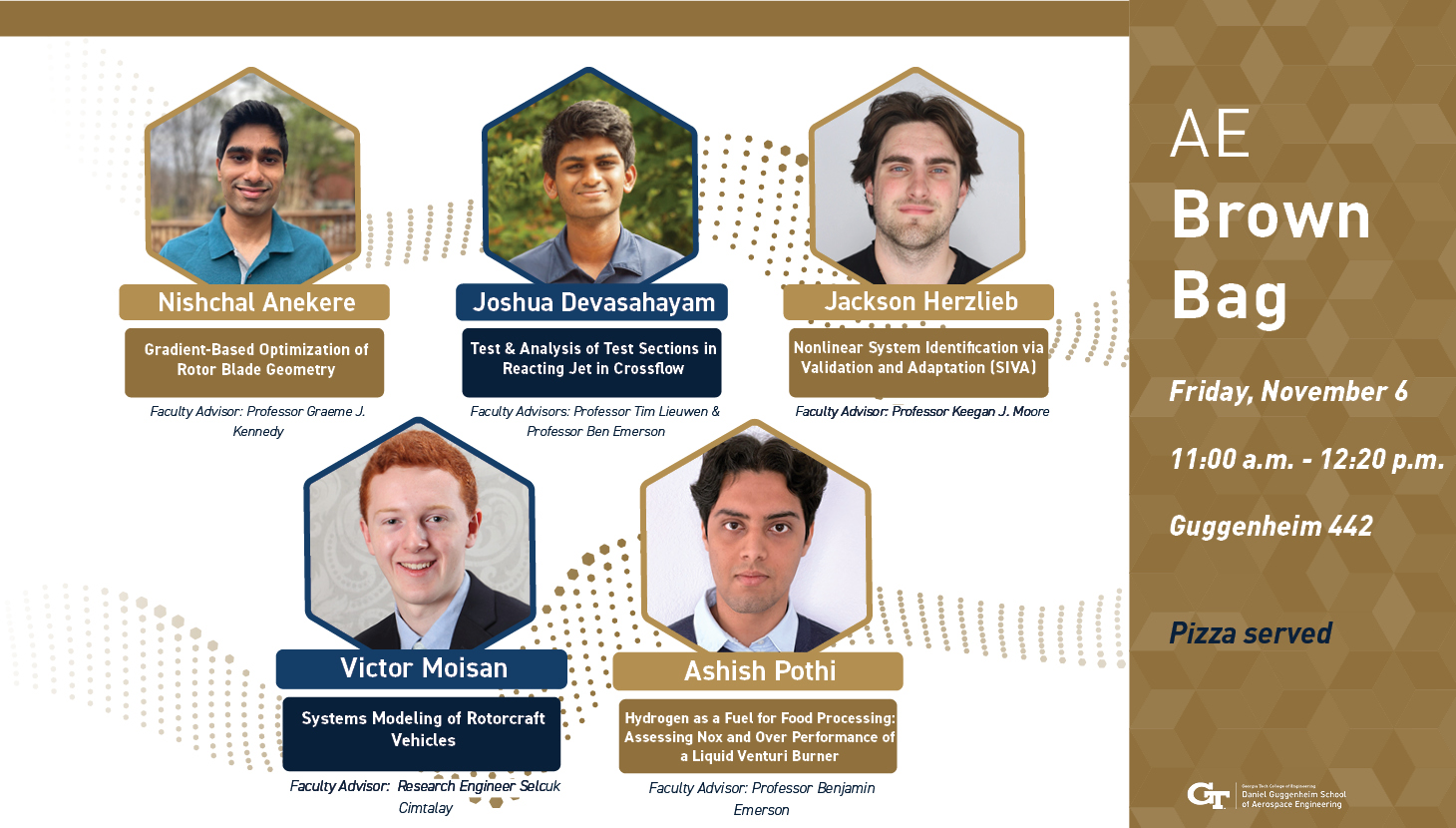
AE Brown Bag Seminar:
Nishchal Anekere
Joshua Devasahayam
Jackson Herzlieb
Victor Moisan
Ashish Pothi
Friday, November 6
11:00 a.m.- 12:20 p.m.
Guggenheim 442
Nishchal Anekere
Seminar Title:
Gradient-Based Optimization of Rotor Blade Geometry
Abstract:
Rotorcraft blade design requires balancing multiple factors, including aerodynamic performance, structural integrity, and operational requirements across varying flight conditions. Among these factors, it is important to consider minimizing rotor power consumption to improve overall rotorcraft efficiency. Blade chord and geometric twist impact aerodynamic loading of blades and create competing demands between induced power and blade profile drag. This research aimed to develop a preliminary rotor blade design tool using a blade element momentum theory (BEMT) model integrated with the OpenMDAO framework. To demonstrate the application of this tool, optimization of the rotor geometry for the Robinson R22 helicopter was performed for a hover hold mission profile, which consisted of axial climb, hover, and axial descent mission segments. Blade root chord, taper ratio, and bilinear twist distributions were varied as design variables while satisfying constraints on performance and geometric constraints. The optimization objective was to minimize mission-weighted power coefficients. Blade geometries that were optimized for induced power only and both induced and profile power were compared. It was found that the induced power only optimization favored greater inboard chord and root-to-tip washout. Meanwhile, including profile power produced a narrower, more tapered blade with lower modeled power requirements across the prescribed mission profile.
Faculty Advisors: Professor Graeme J. Kennedy
Joshua Devasahayam
Victor Moisan
Ashish Pothi
Title:
Hydrogen as a Fuel for Food Processing: Assessing Nox and Over Performance of a Liquid Venturi Burner
Abstract:
Hydrogen can be produced from many sources, and burns to water vapor rather than CO2. This makes it a great candidate fuel for energy intensive food processing. However, there are combustion challenges when it comes to adapting it in cooking appliances, namely flashback and NOx production. The flashback is caused due to the hydrogen’s high flame speed and the thermal NOx is due to the high adiabatic flame temperature in non premixed flames. This presentation reviews two studies of a liquid venturi burner in a water layer which separates the flame and the fuel supply. The first characterizes the burner and compares hydrogen and methane for NOx emissions, heating efficiency and flame structure using IR imaging. The second integrates the burner into a domestic gas oven with feedback controlled cycling and a pilot flame, and then compares both fuels at a fixed 17,000 BTU per hour while measuring the NOx and thermal conductivity of the oven gas. Hydrogen shows a higher efficiency in the bench tests, lower steady state NOx production rate in the oven, and essentially the same heat transfer as methane.
Faculty Advisors: Professor Benjamin Emerson
Jackson Herzlieb
Title:
Nonlinear System Identification via Validation and Adaptation (SIVA)
Abstract:
The recently proposed System Identification via Validation and Adaptation (SIVA) method allows system identification, uncertainty quantification, and model validation directly from data. Inspired by generative modeling, SIVA employs a neural network that converts random noise to physically meaningful parameters. The known equation of motion utilizes these parameters to generate fake accelerations, which are compared to real training data using a mean square error loss. For concurrent parameter validation, independent datasets are passed through the model, and the resulting signals are classified as real or fake by a discriminator network, which guides the parameter-generator network. In this work, we apply SIVA to simulated vibration data from a cantilever beam that contains a lumped mass and a nonlinear end attachment, demonstrating accurate parameter estimation and model updating on complex, highly nonlinear systems.
Faculty Advisors:
Professor Dr. Keegan J. Moore