
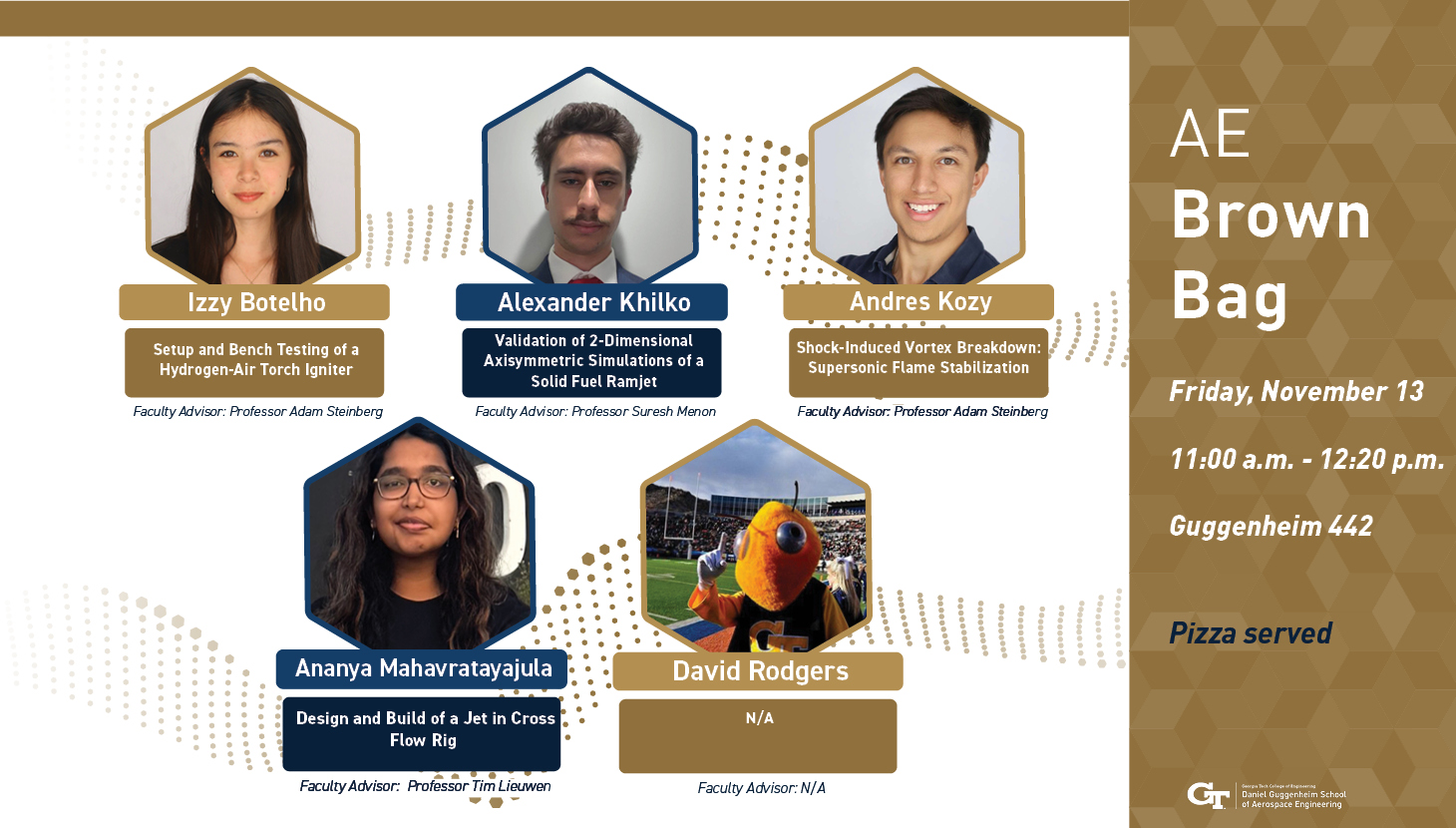
featuring
Izzy Botelho
Alexander Khilko
Andres Kozy
Ananya Mahavratayajula
David Rodgers
Friday, November 20
11:00 a.m. - 12:20 p.m.
Guggenheim 442
Pizza Served
Izzy Botelho
Title:
Setup and Bench Testing of a Hydrogen-Air Torch Igniter
Abstract:
Boom Supersonic is testing their combustor hardware for their newly developed gas turbine engine at the BTZ Combustion lab. During combustor testing, the mechanism for igniting the fuel in the combustor was tested with both a spark igniter and hydrogen-air torch igniter. The torch igniter performed inconsistently, so it was deemed necessary to test it separately from the main combustor test section to determine its stability range. This seminar details the development of an individual test stand for the torch, designed to supply and control air and hydrogen to the igniter as well as acquire temperature and pressure data. The test aims to identify the torch igniter’s stability regime by characterizing the maximum torch temperature at various equivalence ratios. Preliminary testing of the torch at lean conditions established the expected temperature scope and necessitated water cooling of the torch body. Ongoing improvements seek to prepare the torch igniter for richer equivalence ratios ranging from 1 to 5.
Faculty Advisor:
Professor Adam Steinberg
Alexander Khilko
Title:
Validation of 2-Dimensional Axisymmetric Simulations of a Solid Fuel Ramjet
Abstract:
This presentation examines the validity of several 2D models for simulating an axisymmetric solid-fuel ramjet (SFRJ) combustor. SFRJs provide significant advantages in simple geometry, low cost, and a long shelf-life fuel. However, the physics of solid fuel burning are highly complex. The research conducted focuses on a 2D model with 2 different mass transfer models and 3 different heat transfer models. The mass transfer models are an Arrhenius rate based on experimental results and a heat-flux model with a more physical basis. The heat transfer models are a solid-phase heat transfer model to determine the importance of conduction through the fuel and a steady-state analytical and unsteady numerical model. The simulations conducted found that the solid-phase heat transfer is significant to the accuracy and a combination of the Arrhenius rate mass transfer and unsteady numerical heat transfer model was the most valid. Additionally, comparison to previously developed 3D models found that these 2D models are valid for simulating a region 4 step heights along the combustor length. These results show that regions of a combustor can be accurately simulated using a simpler 2D model, avoiding the computational intensity and duration of a 3D model for prototypes and lower accuracy estimates.
Faculty Advisor:
Professor Suresh Menon
Andres Kozy
Title:
Shock-Induced Vortex Breakdown: Supersonic Flame Stabilization
Abstract:
This study investigates shock-induced vortex breakdown enabling flame holding capabilities for supersonic combustion. An alternating ramp Hypermixer and shock generators will be evaluated in a Mach 2 wind tunnel to identify conditions for breakdown. Self-aligned focusing schlieren is used to test density-ratio criterion for breakdown and validate the simulation's recirculation zone predictions.
Faculty Advisor: Professor Adam Steinberg
Ananya Mahavratayajula
Seminar Title:
Design and Build of a Jet in Cross Flow Rig
Abstract:
This presentation highlights the design and build of a reacting and non-reacting jet in cross-flow combustion rig to capture underlying wake vortices. By evaluating reacting and non-reacting flows and comparing normal versus lifted flames, the study ties together concepts in traditional fluid mechanics with an emphasis on wake structures. A PIV optical setup is used to capture the vortex structure across various test conditions by using laser sheets across a velocity gradient for a specific test duration. Design, build, wake structure theory, and PIV optical setup will be discussed in depth.
Faculty Advisor: Professor Tim Lieuwen
David Rodgers
Title:
N/A
Abstract:
N/A
Faculty Advisor:
N/A