
AE Seminar
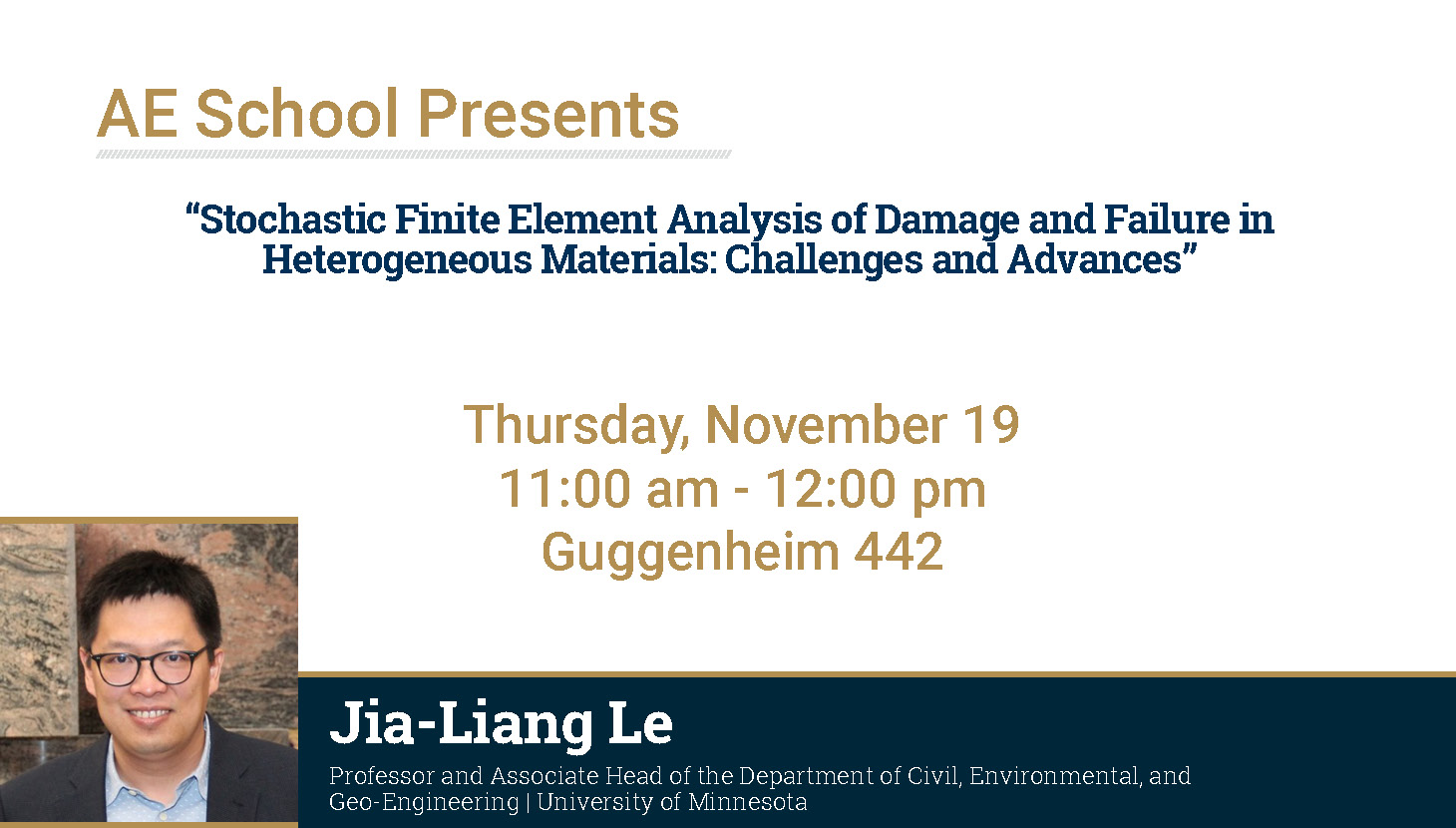
"Stochastic Finite Element Analysis of Damage and Failure in Heterogeneous Materials: Challenges and Advances"
featuring
Jia-Liang Le
Professor and Associate Head of the Department of Civil, Environmental, and Geo-Engineering
University of Minnesota
Thursday, November 19
11:00 - 12:00 p.m.
Guggenheim 442
About the Seminar:
Stochastic finite element (SFE) analysis is a versatile framework for investigating the probabilistic behavior of engineering structures. A central component of SFE analysis is the representation of spatial variability in material properties, typically through random fields defined on sampling grids that capture their spatial correlation. Because these grids rarely coincide with the finite element (FE) mesh, a mapping procedure is required to transfer the spatially varying material properties to the Gauss points of the FE discretization. This issue becomes particularly challenging for heterogeneous materials, which may exhibit complex and evolving failure mechanisms, including damage localization, distributed damage, and transitions between these regimes. Such mechanisms can produce highly inhomogeneous deformation within individual finite elements, making conventional random-field mapping strategies potentially inadequate.
In this talk, we present a new mechanism-based mapping method for random fields of material properties in SFE analyses of heterogeneous materials. The proposed approach is formulated within a continuum damage mechanics framework and introduces two localization parameters to characterize the evolving damage pattern at the element level. These parameters are used to guide energy regularization in the constitutive model and, simultaneously, to control the mapping of random material properties onto the FE mesh. The approach is demonstrated through simulations of bending-beam and cavity-expansion experiments on Dunnville sandstone specimens, which exhibit a broad range of failure patterns. For comparison, two commonly used mapping strategies—the local mapping and local averaging methods—are also considered.
Comparisons between experimental observations and numerical predictions demonstrate the critical importance of coupling the mapping procedure with the evolving mechanical response of individual finite elements to achieve robust and predictive SFE simulations. The results further elucidate the interplay among three length scales—the FE mesh size, the correlation length of the random fields, and the width of the fracture process zone—in determining the performance of different mapping strategies. Finally, the study provides new insights into the experimental calibration and validation of SFE models and highlights important implications for emerging machine-learning-based approaches to constitutive modeling of heterogeneous materials.
About the Speaker:
Dr. Jia-Liang Le is the inaugural MTS Professor and Associate Head of the Department of Civil, Environmental, and Geo-Engineering at the University of Minnesota. He received his Bachelor of Engineering (First Class Honors) and Master of Engineering degrees in Civil Engineering from the National University of Singapore and his Ph.D. in Structural Engineering and Mechanics from Northwestern University. He is a licensed Professional Engineer in Minnesota and a Fellow of the ASCE Engineering Mechanics Institute. Dr. Le serves on the Board of Directors of the Society of Engineering Science and the Board of Governors of the ASCE Engineering Mechanics Institute. He is also President of the International Association of Fracture Mechanics of Concrete and Concrete Structures. His research interests include fracture mechanics, probabilistic mechanics, scaling, computational mechanics, structural stability, and structural reliability. His research has been recognized with numerous honors, including the EMI Leonardo da Vinci Award from ASCE, the Society of Engineering Science Young Investigator Medal, and the Early Achievement Research Award from the International Association for Structural Safety and Reliability (IASSAR).