
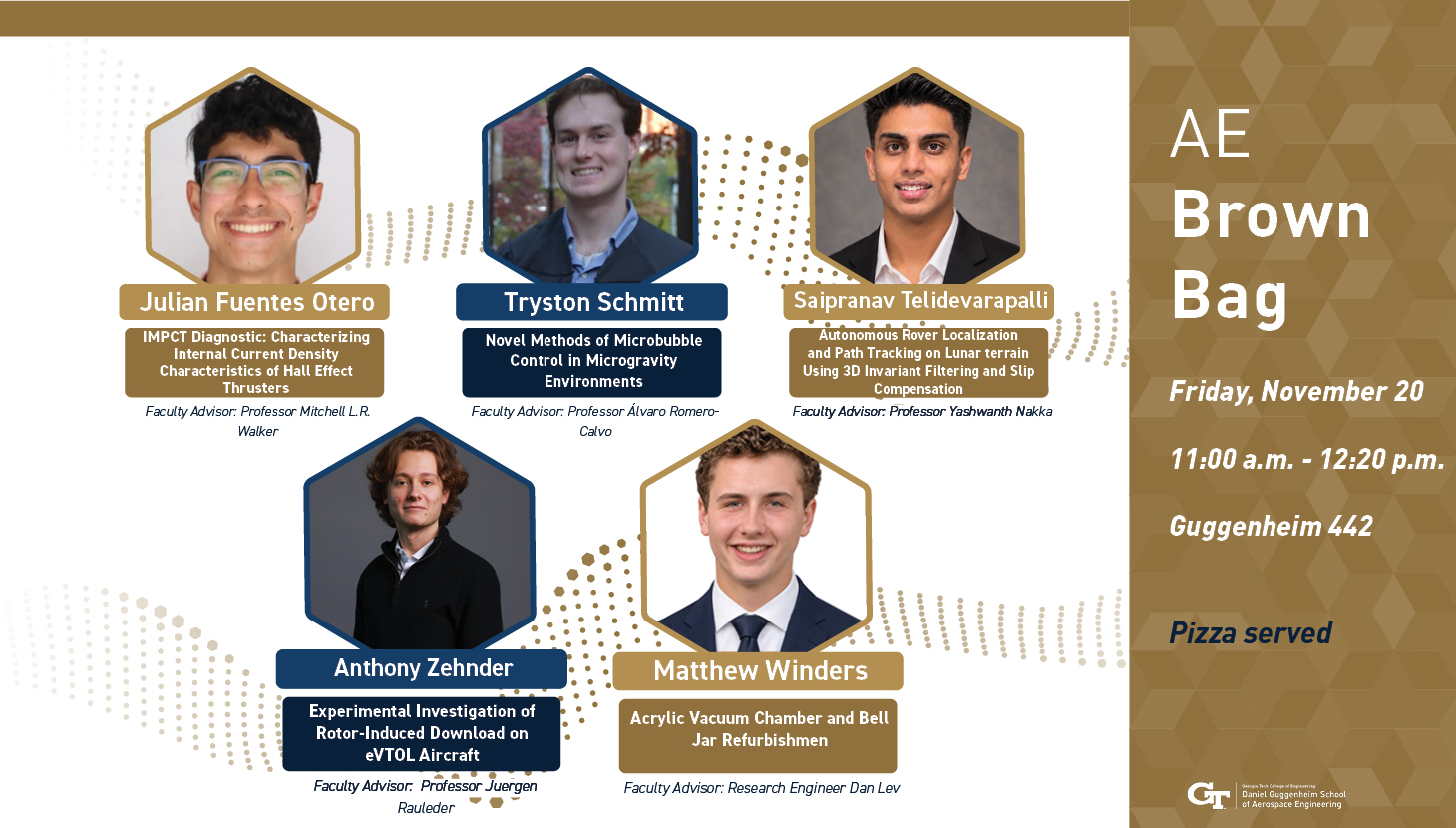
featuring
Julian Fuentes Otero
Tryston Schmitt
Saipranav Telidevarapalli
Anthony Zehnder
Matthew Winders
Friday, November 20
11:00 a.m. - 12:20 p.m.
Guggenheim 442
Pizza Served
Saipranav Telidevarapalli
Title:
Autonomous Rover Localization and Path Tracking on Lunar terrain Using 3D Invariant Filtering and Slip Compensation
Abstract:
Autonomous navigation on deformable granular terrain presents severe challenges for skid-steer rovers, where longitudinal wheel slip routinely exceeds 70% on flat terrain and 85% on slopes. In GPS- and vision-denied environments relying solely on onboard IMU and wheel encoders, conventional planar Extended Kalman Filters suffer from unobservable lateral dynamics and gravity leakage during terrain tilt, leading to rapid covariance divergence and vehicle stall. This talk presents a unified, standalone navigation stack for a Leo Rover operating on loose, sloped terrain without external motion capture. We implement an 18-state Right-Invariant Extended Kalman Filter with Zero-Velocity Updates and non-holonomic constraints, eliminating numerical divergence via decoupled invariant Jacobians. Both the estimator and a nonlinear contraction-metric controller are coupled through a pitch-dependent terramechanics traction model, scaling encoder velocity to ground speed while dynamically boosting uphill wheel torque.
Faculty Advisory:
Professor Yashwanth Nakka
Julian Fuentes Otero
Title:
IMPCT Diagnostic: Characterizing Internal Current Density Characteristics of Hall Effect Thrusters
Abstract:
Within EP research, external probes are typically utilized to gather measurements related to a thruster’s plasma characteristics, such as its charge distribution, breathing modes, and current density among other features. However, these external devices cannot characterize the internal physics of the thruster, in particular key regions within the thruster such as the ionization region, where neutral gases are ionized by radially moving electrons, are poorly understood. As a result, previous literature often assumes the location of the ionization region and its length to be fixed points. Extending on the work of Carl Mullins, the Inverse Magnetostatic Plasma Current Tomography (IMPCT) Diagnostic, developed by HPEPL PhD Student Adrian Vicente La Lande, will be able to characterize the length and current density distribution of the ionization region within the internal channel of a Hall Thruster utilizing an array of magneto-resistive sensors to measure the magnetic field and later backing out the current density through the inverse problem. By working alongside Adrian manufacturing and assembling the diagnostic device, testing of the device will commence in the coming weeks to prove its capabilities.
Faculty Advisor:
Professor Mitchell L.R. Walker
Tryston Schmitt
Title:
Novel Methods of Microbubble Control in Microgravity Environments
Abstract:
Fluid management is essential to spacecraft systems, from propulsion to life support. On Earth, buoyancy drives bubbles to rise, facilitating the separation of gases from liquids. In microgravity, this mechanism is greatly diminished, creating challenges that often require bulky or mechanically complex separation hardware. My research in the Low-Gravity Science and Technology (LGST) Laboratory explores novel, lightweight approaches to bubble management that could simplify fluid handling in space. Through projects investigating magnetic and acoustic techniques, I have contributed to efforts to control bubble behavior and improve gas–liquid separation. These efforts span applications from oxygen generation to cryogenic propellant transfer, addressing critical technological needs for future space exploration and the growing space economy.
Faculty Advisor:
Professor Álvaro Romero-Calvo
Anthony Zehnder
Title:
Experimental Investigation of Rotor-Induced Download on eVTOL Aircraft
Abstract:
As Electric Vertical Takeoff and Landing (eVTOL) aircraft become increasingly prominent,
improving hover efficiency remains an important area of engineering research. This includes
rotor-induced download, in which rotor wakes impinge on the aircraft, generating downward
aerodynamic forces that reduce effective rotor thrust. This research investigates multi-rotor
download by testing a subscale eVTOL configuration with six rotors. The primary objectives are
to quantify rotor-induced download, understand how it varies with rotor speed, and determine
potential design modifications to minimize download in hover. The experimental setup consists
of six-axis load cells mounted to the six rotors as well as the aircraft to experimentally determine
rotor thrust and vehicle download forces. The current focus has been on integrating and
validating the load cells, establishing reliable data acquisition, and minimizing electromagnetic
interference to prepare for initial hover testing. Future experiments will focus on testing the setup
in the wind tunnel in order to quantify multi-rotor download while climbing and descending.
Faculty Advisor:
Professor Juergen Raulede
Matthew Winders
Title:
Acrylic Vacuum Chamber and Bell Jar Refurbishment
Abstract:
Vacuum chambers provide essential infrastructure for ground testing of electric propulsion
systems at the High-Power Electric Propulsion Lab. This project focuses on restoring and
upgrading two vacuum systems, the acrylic vacuum chamber and the bell jar, to expand
experimental capabilities and support future research. The first phase involved returning the
acrylic vacuum chamber to operational service by sizing a replacement roughing pump and
installing a new linear actuation platform for positioning experiments. Additional trade
studies explored potential chamber improvements, including an internal mesh lining intended
to modify charge distribution. The acrylic vacuum chamber has been successfully refurbished
and is now in use. The second phase focuses on restoring the bell jar to operational readiness.
Work has included bringing the electrical system back online, checking the pneumatic system
for leaks, and testing valve actuation. Sealing issues prompted trade studies of potential
design modifications and the identification and sourcing of replacement gaskets. In parallel,
operating procedures were revised to reflect the current system configuration, incorporating
updated references and instructions. Bell jar refurbishment remains ongoing, with the goal of
supporting experiments developed by undergraduate students and collaborative experiments
with other universities. Together, these efforts strengthen the laboratory’s testing
infrastructure through hardware improvements and updated documentation.
Faculty Advisor:
Research Engineer Dan Lev