
Student teams in AE’s inaugural entrepreneurship program developed solutions to improve airport and bridge safety and manufacturing efficiency.
If you’ve ever watched the hit television show “Shark Tank,” you understand the pressure that contestants face when trying to convince a panel of successful judges to invest in their idea. Like those hopefuls, students in the Daniel Guggenheim School of Aerospace Engineering (AE) experienced the same challenge through the AE Entrepreneurship Program (Program), sponsored by Fusen World Inc. (Fusen), where they delivered high-stakes, three-minute pitches in the hopes of earning funding.
Three teams, AirfieldIQ, Reforge Industries, and Verus. came out victorious in the Program’s inaugural competition in 2026. Each team received $150,000 in equity-based funding, including $25,000 upfront and the remainder awarded as proof-of-concept milestones are met.
The Program was established through AE, in partnership with Fusen World Inc. (Fusen), founded by Georgia Tech alumnus Chris Klaus. He founded his first company, Internet Security Systems, as a student and later sold it for nearly $1.2 billion to IBM. He also founded Kaneva, an American video game company. He has since invested in more than 200 student-founded startups and supported accelerator programs, including Georgia Tech’s CREATE-X.
Program lead Joe Oefelein, associate chair for the Undergraduate Program in AE, and Jen Whitlow, community partnerships lead at Fusen, hosted an information campaign in Fall 2025 to launch the initiative, which aims to translate technical ideas into viable ventures.
“When you’re building a minimum viable product (MVP), the goal is to create something you can demonstrate to generate investor interest. Many startups go this route because they need external funding to get off the ground. Unlike a traditional ‘mom-and-pop’ business that can grow gradually by reinvesting, startups often require significant upfront capital,” Oefelein stated.
The competition began at the beginning of Spring 2026 with 14 teams of AE undergraduate students, though interdisciplinary teams were strongly encouraged and often needed. The Program provided structured workshops and mentorship, guiding students from problem identification to pitch development. Sessions covered ideation, business models, MVP development, storytelling, and pitching, while mentors offered feedback on both technical and communication strategies.
Students showcased their projects on Demo Day during the last week of the semester. Teams pitched the judges, who deliberated and announced the winners the same day. Each team had three minutes to pitch their idea to a panel of judges that included Klaus and industry leaders from aerospace, technology, and venture capital. While one winning team was a possibility, Klaus and the judges were so impressed by the strength of the competitors that they ultimately chose to fund three teams.

The Winners Circle

AirfieldIQ
The AirfieldIQ team, Andy Cheng, Henry Dowling, Ruelin Man-Martinez, Jonathan Shi, and Muhammad Sarguroh were among those awarded. They proposed an autonomous system that would detect foreign object debris and damaged runway lights. These airports do inspections twice a day while AirfieldIQ’s system would work continuously. Larger airports like John F. Kennedy International Airport have these types of systems but they are very costly. Regional airports don’t have cost effective systems. In preparation, the team spoke with six airport operations managers from various Georgia and South Carolina regional airports for feedback.
“As an engineer, all you want to do is talk about the cool tech behind your product. When pitching, however, you need to tell a story about the problem you’re actually solving and how your solution addresses it,” said third-year student Dowling. He wanted to do an aerospace start up since his first year at Tech during Week of Welcome, but AE’s program had yet to begin. He and the other team members met at Tech’s Oxford Study Abroad Program in 2024 and when AE announced the Program they knew they wanted to build something. The workshops and mentorship helped them refine their project and their pitch. The feedback that stood out to Dowling was to speak more conversationally when presenting.
“I practiced a lot with my friends. Condensing the pitch into three minutes with so many points to convey was challenging. We developed a script to streamline the narrative, then revised it to flow naturally.”

Reforge Industries
Vincent Rullo working independently on his startup project, discovered a major industry problem firsthand during a summer internship as a manufacturing engineer: the factory maintenance supervisors who keep aging production machinery running are up against a broken spare-parts supply chain. In conversations with the supervisors he worked alongside, Rullo learned that the critical components their teams need to keep high-value production lines running are often discontinued, backordered, or available only through a tangle of middlemen and custom fabricators. Even something as ordinary as a custom housing or bracket could take months to ship, and a single unscheduled stockout could shut a multi-million-dollar line down for days, costing the company millions in wasted labor and lost production.
Rullo pitched a solution: leverage emerging technologies to reverse-engineer those critical components, manufacture them on demand, and deliver them in hours, not weeks, sparing maintenance supervisors the threat of a missing spare ruining their company's quarter.
Rullo spent hours winnowing his pitch into the required three minutes. To make it compelling, he drew on lessons from conversations with Professor Craig Forest, co-founder and organizer of the InVenture Prize. "What makes an effective presentation is really hammering home how visceral the problem is," Rullo said. "Only after you establish how much the problem costs the customer will your solution make sense to investors."
Rullo is currently working with CREATE-X this summer to further develop his winning project, which has since pivoted toward leveraging advanced manufacturing and an online instant-quoting engine to provide affordable, on-demand manufacturing services for individuals, startups, and small businesses.

Verus
First-years Taran Govindu and Aiden Erard conceptualized an AI-powered software that will automate bridge inspection data analysis. Their software analyzes ground penetrating radar (GPR) data and turns it into an engineer-ready condition map. This data is taken during bridge inspection and focuses on structural integrity of rebar.
Their software addresses slow, complex data analysis that currently delays inspection reports, potentially reducing turnaround time from weeks to minutes.
The team started with the idea of somehow using drones and bridge inspections, but halfway through the Program workshops and customer discoveries, they figured out the actual problem and centered on the analysis side.
“I found the workshops and speaker sessions incredibly valuable, especially because they covered key topics like customer discovery, market evaluation, and building a strong pitch deck, which directly supported our project,” Govindu said. “We also benefited from recorded notes, organized materials, and accessible mentors, all of which helped us refine our idea and prepare confidently for Demo Day."

The Program will continue this fall. Stay tuned for the fall information sessions.
(text and background only visible when logged in)
Related Stories:

CREATE-X Startup Brings Digital Access to the Unbanked
Victor Espinosa, Founder of Loto Punto, stands in front of his product, pitching it on Columbia's Shark Tank
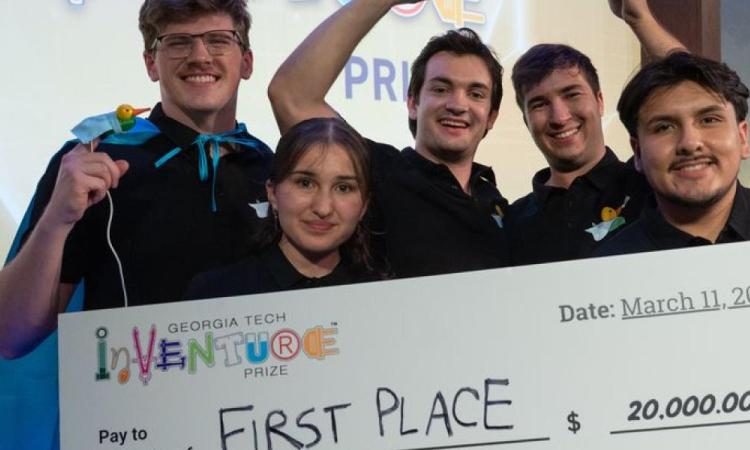
InVenture Prize
Nicknamed "American Idol for Nerds," the Emmy Award-winning InVenture Prize at Georgia Tech is an interdisciplinary innovation competition open to all undergraduate students and recent graduates of the Georgia Institute of Technology.