
Professor Joe Oefelein’s RAPTOR framework uses Frontier to advance simulations for supersonic propulsion.

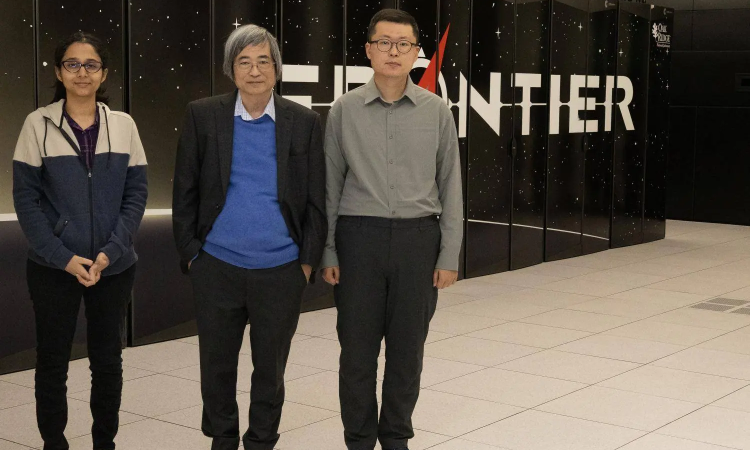
Associate Chair for Undergraduate Programs Joseph Oefelein, Joshua Sykes, and Dhruv Purushotham taken from the Frontier observation deck at Oak Ridge National Laboratory
Flying at supersonic speeds creates an extraordinarily complex environment where turbulence, fuel injection, combustion, shock waves, boundary layers, and heat transfer interact across a vast range of spatial and temporal scales. Until recently, these tightly coupled processes could not be resolved with sufficient reliability to fully understand or accurately predict their behavior.
Now, with access to Frontier, the world's first exascale supercomputer, Georgia Tech researchers are pushing beyond those limitations. Professor Joe Oefelein and Research Engineer Dhruv Purushotham have received a prestigious three-year U.S. Department of Energy (DOE) Innovative and Novel Computational Impact on Theory and Experiment (INCITE) award providing 700,000 Frontier node-hours annually, equivalent to approximately $1.6 million per year, or nearly $5 million in leadership-class computing resources over the life of the project. INCITE is DOE's flagship leadership computing allocation program and ranks among the nation's most competitive awards in computational science.
Central to the effort is RAPTOR (Runtime Accelerated Platform for Thermofluid simulatiOn and Research), a massively parallel simulation framework developed by Professor Oefelein over the course of his research career. Purpose-built for turbulent reacting flows, RAPTOR integrates advanced numerical algorithms with detailed chemistry, thermodynamics, transport physics, turbulence modeling, and shock-capturing methods. Optimized for GPU-accelerated supercomputers, the framework enables the use of Frontier to perform simulations that were previously beyond reach.

"We want clean and efficient energy, not only in terms of performance, but also affordability," Oefelein said. "Improving fuel efficiency lowers operating costs while increasing reliability and safety. Those advances ultimately benefit everyone who relies on air transportation."
Joseph Oefelein
The research focuses on propulsion concepts for next-generation supersonic transport and other advanced air-breathing propulsion systems. Conducted in close collaboration with experimental teams at the Air Force Research Laboratory and Purdue University, the project provides high-fidelity simulations that replicate the experimental geometry and operating conditions, complementing laboratory measurements with insight into otherwise inaccessible flow physics while validating next-generation predictive engineering models.
One focus of the project is understanding how flame holders create recirculation zones that stabilize combustion in supersonic flow environments. These localized low-speed regions anchor the flame despite the surrounding supersonic airflow, enabling stable combustion under conditions that would otherwise extinguish the flame. Understanding these interactions is essential for designing safe, reliable, and fuel-efficient propulsion systems.
Beyond advancing the fundamental understanding of turbulent reacting flows, the project will produce benchmark simulation databases and predictive engineering models that will accelerate the development of future gas turbines, rotating detonation engines, scramjets, and other advanced propulsion technologies.
Exploring how these processes behave in a supersonic environment will lead to advanced engines that don’t even exist yet.

Simulation showing the disparity in turbulent length scales in the flame holding region of the experimental gas turbine burner. It also shows the complex shock structure that exists in the vicinity of the flame.
Related Stories:
Computing Turbulence on the World’s Fastest Computer
P.K. Yeung receives Department of Energy INCITE Award and access to exascale computing resources.

National Academy of Science Recognizes P.K. Yeung's Research on Turbulence
Foundational research in turbulent fluid flows headed up by Professor P.K. Yeung has been published in the Proceedings of the National Academy of Sciences (PNAS).