
AE Seminar
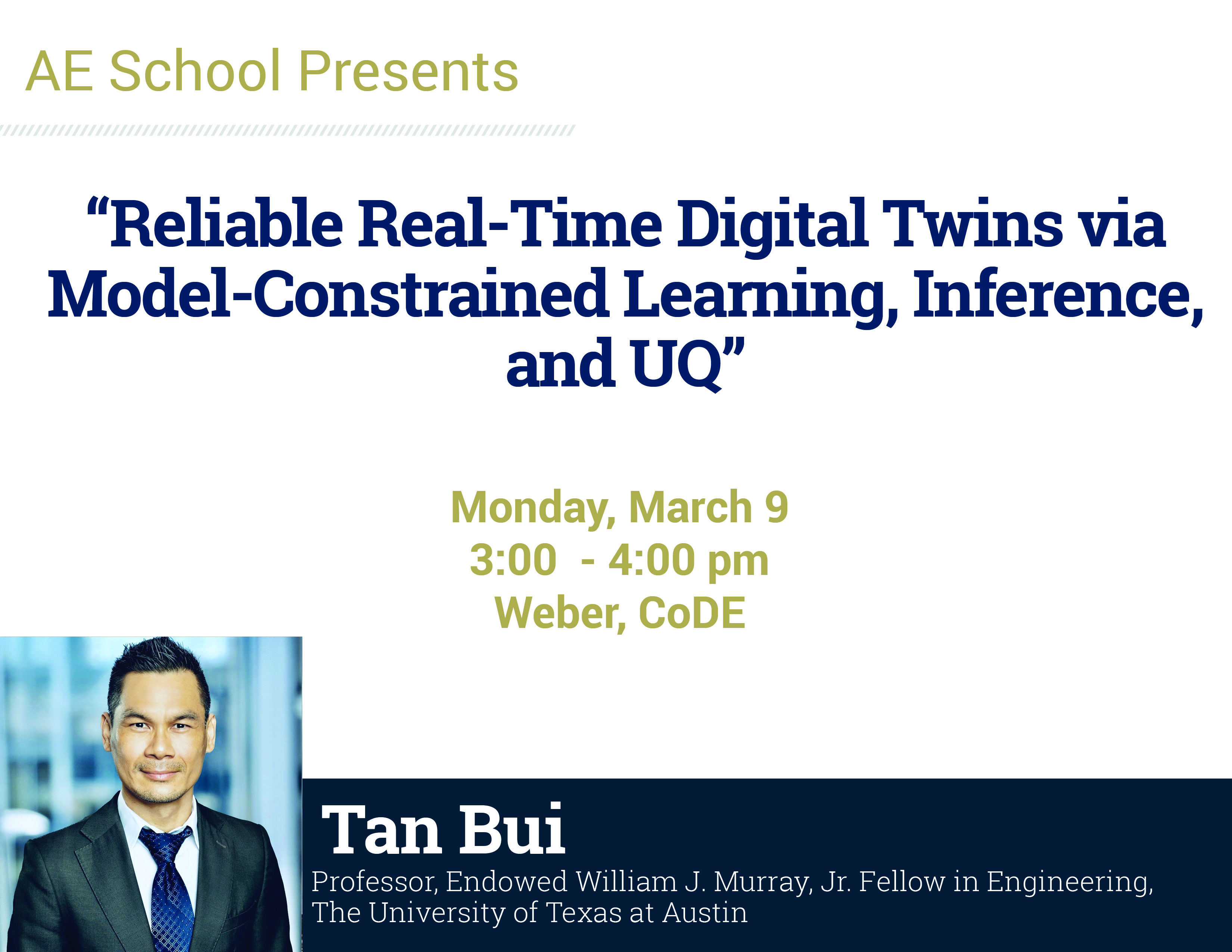
Reliable Real-Time Digital Twins via Model-Constrained Learning, Inference, and UQ
featuring
Tan Bui
Professor and the Endowed William J. Murray, Jr. Fellow in Engineering, The University of Texas at Austin
Mon. March 9
3:00 pm
Weber, CoDE
About the Seminar:
Over the past two decades, my research has built a unified computational foundation for reliable, real-time digital twins of nonlinear aerospace systems. In this talk, I will connect four threads of contributions that collectively span the digital-twin pipeline: fast predictive modeling, high-fidelity physics discretization, calibration and inference from data, and uncertainty-aware decision support. First, I will revisit my model-constrained reduced-order modeling for transonic turbomachinery flows, developed to enable rapid “what-if” prediction with probabilistic outputs: a capability that is central to operational digital twins. Second, I will summarize my contributions to high-order discontinuous Galerkin (DG) and related discretizations for fluids, waves, and magnetohydrodynamics, which provide a stable and accurate physics backbone and a natural foundation for model-constrained SciML and reduced-order surrogates. Third, I will present my work on PDE-governed Bayesian inverse problems, establishing a scalable methodology for calibration, data assimilation, and uncertainty quantification that turns sensor data into updated state/parameter estimates with quantified credibility. Finally, I will focus on recent advances in real-time scientific machine learning for forward modeling, inverse problems, and UQ in aerospace-relevant regimes, emphasizing stability, generalization, and reliability under distribution shift. Across these results, the unifying theme is a principled pathway from computational science, engineering, and mathematics to deployable digital twins: methods that remain faithful to physics and numerical structure, are computationally efficient, and come with defensible uncertainty statements suitable for engineering decisions. I will illustrate the approach using representative nonlinear PDE systems arising in aerospace and related flows, including the Euler equations (with transonic and hypersonic regimes), the Navier–Stokes equations, and airfoil aeroelastic systems, and I will close with a defense-motivated example demonstrating how rigorously constrained learning enables deployable digital-twin capabilities.
About the Speaker:
Tan Bui is a Professor and the Endowed William J. Murray, Jr. Fellow in Engineering No. 4 at The University of Texas at Austin (Oden Institute for Computational Engineering and Sciences and the Department of Aerospace Engineering and Engineering Mechanics). He is also the Director of the Center for Scientific Machine Learning. He earned his Ph.D. in Computational Fluid Dynamics from MIT’s Department of Aeronautics and Astronautics in 2007, where he developed model-constrained model-reduction methods for large-scale aerodynamic systems. For over 26 years, his career has focused on computational science, engineering, and mathematics, advancing the mathematical, algorithmic, and computational foundations needed for reliable prediction, inversion, and uncertainty quantification in complex multiscale, multiphysics systems governed by partial differential equations. Professor Bui has held several leadership roles in the scientific computing community, including elected Vice President of the SIAM Texas–Louisiana Section and elected Secretary of the SIAM Activity Group on Computational Science and Engineering (SIAG/CSE). His honors include an NSF CAREER Award (jointly funded by the Office of Advanced Cyberinfrastructure and the Division of Mathematical Sciences), the Oden Institute Distinguished Research Award, two Moncrief Faculty Challenging Awards, and recognition as a Gordon Bell Prize finalist.