
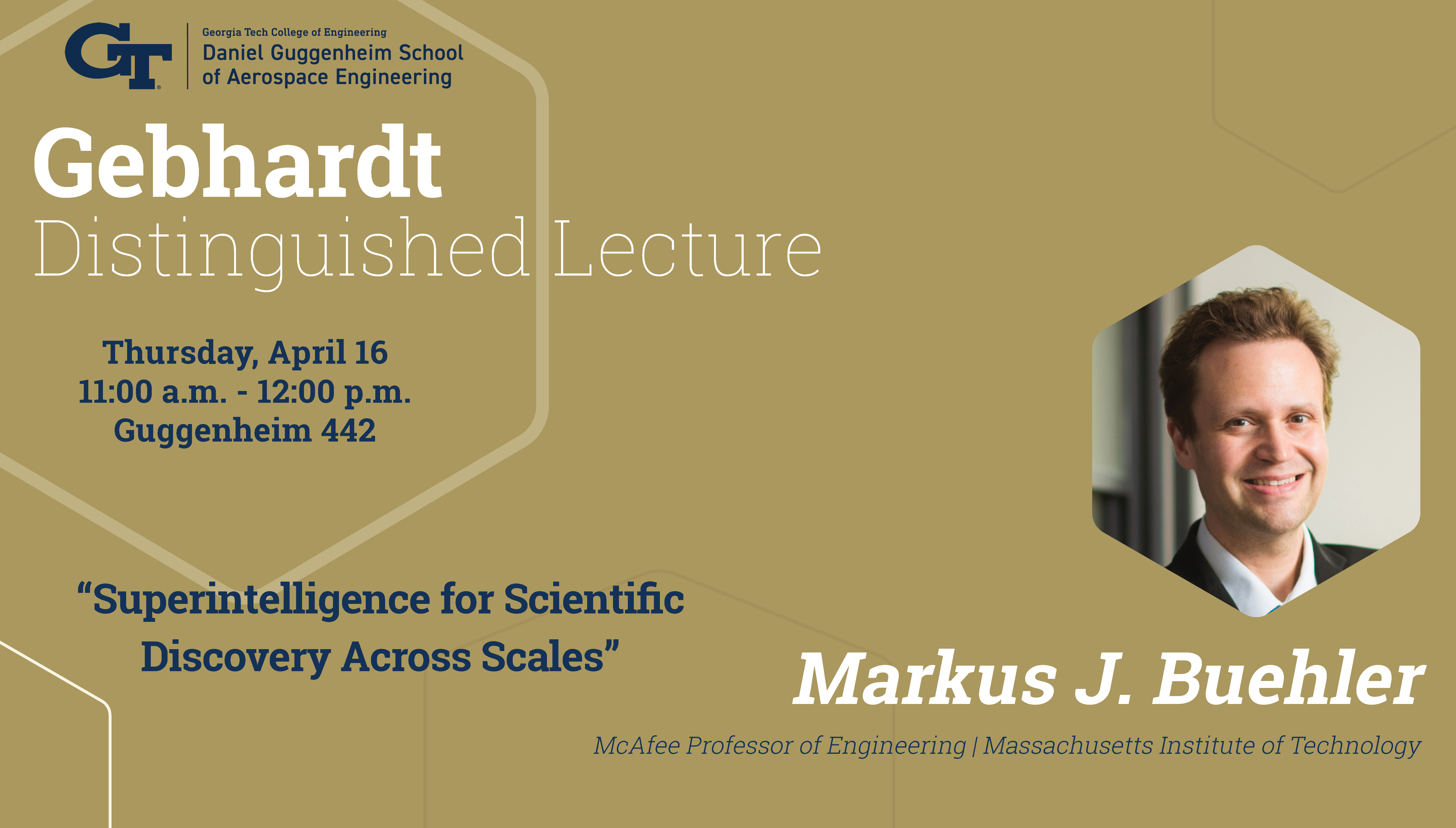
Gebhardt Distinguished Lecture
"Superintelligence for Scientific Discovery Across Scales"
featuring
Markus J. Buehler
McAfee Professor of Engineering | Massachusetts Institute of Technology
Thursday, April 16
11:00 a.m. - 12:00 p.m.
Guggenheim 442
About the Seminar:
AI is rapidly transitioning from a passive analytical assistant to an active, self-improving partner in scientific discovery. In the material world, this shift means developing systems that not only recognize patterns but also reason, hypothesize, and autonomously explore new ideas for design, discovery and manufacturing. This talk presents emerging approaches toward 'superintelligent' discovery engines -integrating reinforcement learning, graph-based reasoning, and physics-informed neural architectures with generative models capable of cross-domain synthesis. We explore multi-agent swarm systems inspired by collective intelligence in nature, enabling continuous self-evolution as they solve problems. Case studies from materials science, engineering and biology illustrate how these systems can uncover hidden structure-property relationships, design novel materials, and accelerate innovations in biology and beyond. These advances chart a path toward AI that actively expands the boundaries of human knowledge.
About the Speaker:
Markus J. Buehler is the McAfee Professor of Engineering at MIT, a pioneer in AI‑driven knowledge discovery, and the co-founder of the AI startup Unreasonable Labs. He created powerful graph‑aware, multi‑agent AI platforms that turn heterogeneous data into science-grounded actionable insight, powering breakthroughs in materials science, biology and healthcare. Buehler is among the world’s most‑cited materials scientists and the recipient of numerous honors, including the Feynman Prize, ASME Drucker Medal, J. R. Rice Medal, and the Washington Award. He is a member of the U.S. National Academy of Engineering. For more than a decade he has also taught executive and technical professionals at MIT, shaping the next generation of leaders in engineering, knowledge discovery, and artificial intelligence.