
AE Seminar
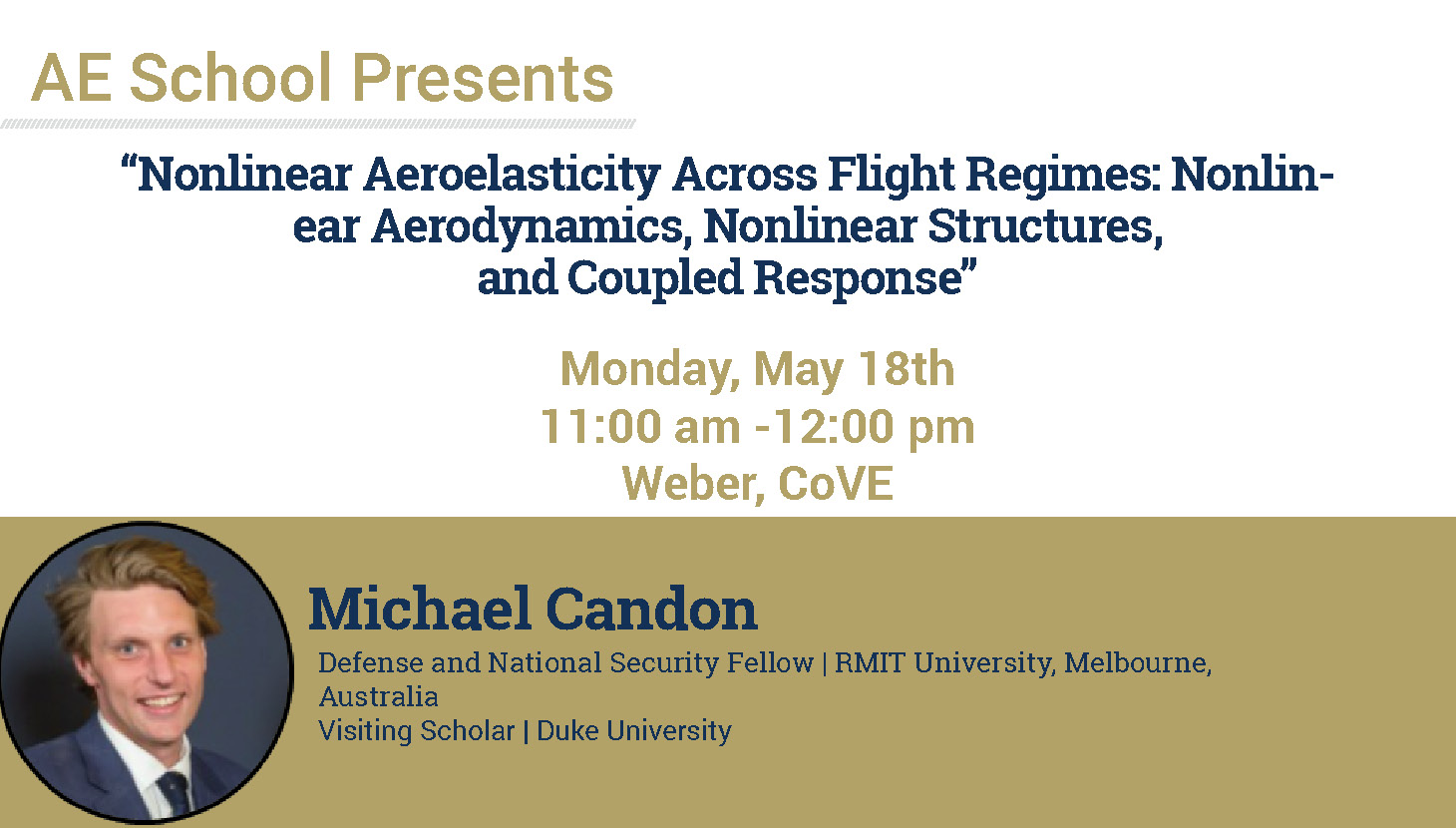
"Nonlinear Aeroelasticity Across Flight Regimes: Nonlinear Aerodynamics, Nonlinear Structures, and Coupled Response"
featuring
Michael Candon
Defense and National Security Fellow in the Aerospace Engineering Department
RMIT University, Melbourne, Australia
&
Visiting Scholar
Thomas Lord Department of Mechanical Engineering & Materials Science
Duke University
Monday, May 18th
11:00 a.m.
Weber, CoVE
About the Seminar:
Aeroelastic instabilities, including flutter, limit cycle oscillation (LCO), and buffet-driven responses, are critical challenges for modern high-performance aircraft. These phenomena are often governed by nonlinear aerodynamics, nonlinear structural dynamics, or the interaction between the two. Across different flight regimes, effects such as flow separation, shock motion, shock-boundary-layer interaction, fluid-thermal-structural interaction (FTSI), geometric structural nonlinearity, and freeplay can produce complex aeroelastic behavior that is difficult to predict using linear methods. This seminar will provide some background on nonlinear aeroelasticity, with emphasis on the coupled roles of aerodynamic and structural nonlinearities. Case studies may include transonic flutter, transonic shock buffet and buffet-driven aeroelasticity, nonlinear structural effects, low-speed highly flexible wings, and high-speed FTSI problems. The seminar will include elements of full-fidelity CFD-based simulation, data-driven reduced-order modeling, and linearization, highlighting how these tools can be used together to interpret and predict nonlinear aeroelastic response.
About the Speaker:
Dr. Michael Candon is a Defence and National Security Fellow in the Aerospace Engineering Department at RMIT University, Melbourne, AU, and currently a Visiting Scholar at Duke University with Prof. Earl Dowell for six months. Dr Candon specializes in CFD-based aeroelastic modelling, including combined nonlinear aerodynamic and structural mechanisms, and transonic buffeting flows. He has also worked extensively on the integration of machine learning approaches for aircraft Prognostics and Health Management, maritime flow-structure interactions, and hypersonic system modeling and optimization. His research is funded by US Air Force Office of Scientific Research, Australian Research Council and Australian Economic Accelerator, with a total income of more than AUD 5 million. Dr Candon’s education includes a PhD in Aerospace Engineering under the supervision of Prof. Pier Marzocca, and a BEng (Hons.), both at RMIT University. In recognition of his research contributions, Dr Candon has received numerous awards from such bodies as the Royal Aeronautical Society, Royal Institute of Naval Architects, and Defence Materials and Technology Centre.