
A $1.5 million NASA award will support aerospace education, workforce development, and entrepreneurship programs across Georgia.

Georgia Tech is leading a new NASA-supported workforce development initiative designed to expand aerospace education and strengthen Georgia's pipeline of skilled technical talent needed for future space missions.
Through a Next Gen STEM (NGS) NASA Aerospace Skilled Technical Workforce Hubs (NAS_Hub) grant award, Georgia Tech will play a central role in addressing a critical labor shortage in the booming aerospace industry and enhance the state’s role as an aerospace industry leader in the global space economy.
Beginning this fall, the three-year, $1.5 million award will establish the Southeast Space Technology & Aerospace Readiness Skills (SE-STARS) Hub. The hub will expand opportunities for training and workforce readiness in high-demand technical careers in aerospace.
The SE-STARS Hub includes the Georgia Space Grant Consortium (GSGC), Georgia Tech’s Space Research Institute (SRI), the Georgia Tech Manufacturing Institute (GTMI), the Technical College System of Georgia (TCSG), Georgia Southern University, Georgia College and Career Academies, Georgia Aerospace & Defense Alliance (GADA), and select Georgia aerospace employers to support the growing aerospace industry and NASA missions.
Aerospace products are Georgia’s No. 1 export and the state has more than 800 companies supporting aviation, manufacturing, research, maintenance, repair, and operations.
Many aerospace and engineering positions rely on skilled technical workers whose training pathways do not require a four-year, or advanced degree. There are significant gaps in technical roles such as machinists, electronics technicians, test operators, and systems integrators. These shortages are driven by an aging workforce and a projected national shortfall of at least one million skilled technical workers by 2030. (National Academics of Sciences, Engineering, Medicine, 2025).
The gap also stems from the rapid pace of technological advancement, where even current skills can quickly become obsolete if not constantly renewed. All this combines to create an urgent need for training to support new and sustainable aerospace career pathways.
Stephen Ruffin, interim chair of the Daniel Guggenheim School of Aerospace Engineering and GSGC director will serve as the principal investigator (PI). Jud Ready, executive director of SRI; Lori Skillings, GSGC; Hossein Taheri, Georgia Southern University; and Steven Ferguson, GTMI, will serve as co-PIs. Jeffrey McNabb, a research engineer in Georgia Tech’s Aerospace Systems Design Lab (ASDL), will serve as the program manager, leading day-to-day operations and coordinating the project team.
"This initiative strengthens Georgia's position as a leader in aerospace innovation and manufacturing while providing new opportunities for students and industries across the state," said Ruffin.
Coordination between public education systems, industry, and workforce agencies can sometimes be limited. SE-STARS will act as a "hub" to bridge these gaps, connecting Georgia Tech and its specialized research institutes with TCSG’s 22 colleges and 88 campuses to provide statewide access to training.
“Another advantage of the program is the stronger network it creates,” said Ruffin. “Each organization in the SE-STARS team has unique capabilities but together we will strengthen the technical workforce pipeline across Georgia and the broader Southeast.”
The SE-STARS team will collaborate with industry partners to develop curriculum aligned with workforce needs. “The easily ported curricula we develop will be tailored for other institutions to adopt directly, creating a consistent foundation of skills and competencies that employers can universally expect from program graduates across Georgia,” Ready said.
Students will access training through a statewide network of technical colleges serving as regional instructional nodes, which offer flexible online options and hands-on paid apprenticeships to ensure broad geographic reach.
The program also reaches K-12 and adult learners through career academies and specialized STEM labs, creating a structured, sustainable transition from early education to high-demand aerospace credentials. GTMI will support this work through its Advanced Manufacturing Pathways Program, which connects industry-informed training with pathways into high-demand advanced manufacturing careers.
“Georgia's expanding aerospace and space sectors are creating high-paying jobs and driving economic growth,” said Ruffin. “This program will help develop the skilled workforce needed to support that growth and Georgia’s competitiveness in the space economy.”


W. Jud Ready
Related Story:
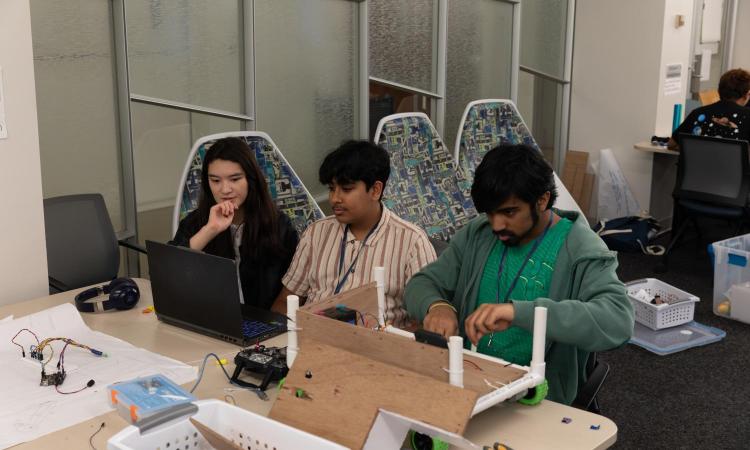
How Georgia Tech's STEP Camp Is Expanding Engineering Opportunities Across Georgia
STEP Camp is expanding across the state, giving high school students hands-on engineering experience through immersive, team-based challenges. From the tarmac to the classroom, Georgia Tech's Science, Technology and Engineering Program (STEP) Camp is reaching students across Georgia with immersive engineering experiences.
What began as a single Atlanta-based program, hosted by the Daniel Guggenheim School of Aerospace Engineering (AE), now includes four camps, introducing students to real-world engineering challenges while helping them explore potential pathways in STEM.
(text and background only visible when logged in)