
STEP Camp is expanding across the state, giving high school students hands-on engineering experience through immersive, team-based challenges.

Students working on rover design.
From the tarmac to the classroom, Georgia Tech's Science, Technology and Engineering Program (STEP) Camp is reaching students across Georgia with immersive engineering experiences.
What began as a single Atlanta-based program, hosted by the Daniel Guggenheim School of Aerospace Engineering (AE), now includes four camps, introducing students to real-world engineering challenges while helping them explore potential pathways in STEM.
For Nickarion Noel, a rising junior from Stone Mountain, STEP offered a chance to move beyond traditional classroom instruction and gain hands-on exposure.
"I wanted experience in STEM and the opportunity to learn at Georgia Tech, which is my dream school," Noel said. "I wanted to see if engineering was something I wanted to pursue, and now I know it is."

Student Nickarion Noel


Led by Senior Lecturer Kelly Griendling, STEP places students in teams to tackle engineering challenges over two weeks. With support from Program Support Coordinator Alysia Watson and AE student mentors, participants learn to apply engineering concepts through design, building, testing, and problem-solving.
The challenges may vary, but the core idea is that students work in teams to build something that solves a problem.
“It’s like language immersion when you visit another country,” Griendling said. “Learning accelerates far beyond what you’d experience in a traditional classroom. This camp offers similar immersion in engineering.”
The Fantastic Four
The first camp, TryEngineering Summer Institute, was a one-week residential program in Atlanta hosted in partnership with the College of Engineering, the Georgia Space Grant Consortium, IEEE, and National Student Leadership Conference (NSLC). The camp tasked students with building boats capable of completing a payload delivery mission. In addition to project work, students attended the Space Explorers Infinite Exhibit, a virtual space exploration experience inspired by NASA missions, where they explored the International Space Station using virtual reality.
The other three camps were funded primarily through an Office of Naval Research (ONR) grant, with additional support from the Georgia Space Grant Consortium. Offered at no cost to participants, the camps featured a variety of hands-on engineering challenges.
“The School of AE is committed to working with the College of Engineering and other partners to conduct these impactful programs. What Griendling does in leadership of these programs is unique. She is a unicorn"
Interim AE Chair and Director of GSGC, Stephen Ruffin.

Students collaborate on rover building in the Loewy Library in Montgomery Knight.

Students working on electrical components of rover in Loewy Library in Montgomery Knight.

Students testing their rover in the Montgomery Knight hallway.
In Augusta, students designed drones for emergency-response missions while learning directly from firefighters and state patrol officers about real-world applications. In Albany, students completed NASA-inspired rover projects through STEP's continuing partnership with 4C Academy.
The Atlanta camp challenged 56 students in 11 student teams to design their own planetary exploration mission and create a rover capable of completing their chosen mission. Working through the full engineering design process, students learn both systems thinking and practical technical skills. Participants used Onshape to design and 3D print rover components and Arduino to develop electrical systems, preparing them to carry these skills into real world engineering.

Student Anaya Gupta
“We chose to design a rover for the planet Titan because of its smooth, icy surface. Accessible lakes made it ideal for collecting samples,” Noel said. “Our biggest challenge was that the stepper motors couldn’t lift our 3D-printed component, but after switching to more powerful DC motors, the system worked.”
For Anaya Gupta of Decatur, the program also provided new technical skills.
"I learned to use Onshape, which is a CAD program," Gupta said. "It was challenging at first, but I watched YouTube videos and relied on mentors and my teammates. Eventually, I was able to 3D-print pieces for our rover project."
At the conclusion of each camp, students present their work to peers, faculty members, and family members, sharing both their final designs and the challenges they overcame during the engineering process.

Students present their projects to a full house in Weber CoVE.

Interim AE Chair and Director of GSGC, Stephen Ruffin thanks Professor Kelly Griendling at the STEP Camp Presentation Event.

Students give an overview of their project and the challenges they faced and overcame.
Sustaining Growth While Scaling Impact
STEP has been going strong for 12 years and receives over 500 applications annually. Students are selected through a lottery system. While STEP leaders would like to expand participation to every Georgia high school student, capacity remains limited. The biggest obstacle is securing continued funding. Sustaining and growing the program requires ongoing investment to support instructional materials, student activities, facilities, and the dedicated staff who make these high-quality experiences possible for students across Georgia.
In addition to coordination, the program requires instructors with broad engineering expertise.
“We expect students to encounter unpredictable challenges,” Griendling said. “Instructors must be comfortable troubleshooting across electronics, mechanical systems, and software.”
The time constraints of summer and the limited space and facilities are also barriers to program growth.
“Georgia’s summer break is only about eight weeks,” Griendling said. “Once you remove the first and last weeks, we’re left with six. That means our camps must overlap, making staffing and coordination complex.”
Despite the logistical and resource challenges that come with operating multiple camps simultaneously, the STEP team remains focused on providing students with the kind of immersive engineering experience that has defined the program for more than a decade.
Griendling often sees the students come full circle. Two STEP mentors, Jamie Conde and Kaylin Wu, came through the camp as high school students and now guide the next generation of aspiring engineers.
“There is so much that goes into putting the camp together and running the camp that you don’t see as a student,” Conde shared.
For Griendling, experiences like theirs represent the program’s lasting impact. Students who once arrived to explore engineering are now returning to help inspire others to pursue it.
Related Stories
Georgia Tech STEP Camp Exposes Students to the Possibilities in Engineering
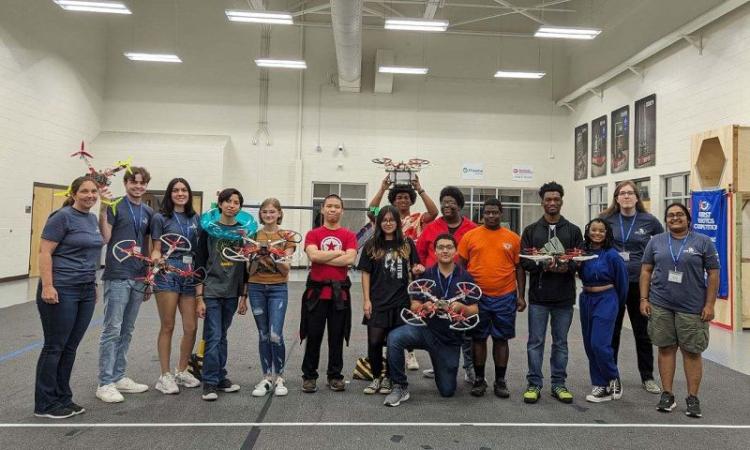
The program expands to serve a new community.While some teenagers were lounging in the pool this summer, the Science, Technology, and Engineering Program (STEP) campers were building Mars rovers and operation-based drones. Now in its ninth year, the STEP Program at Georgia Tech is a free summer camp where high school students learn the engineering design process by completing task-based challenges.
This year, for the first time, the camp hosted two sessions. One in Albany, Georgia, to serve the state’s rural population, and the other on the Georgia Tech Atlanta campus. The participants in Albany were challenged to design a delivery drone, while those in Atlanta built rovers for Mars.
AE STEP Camp Going Strong After 10 Years
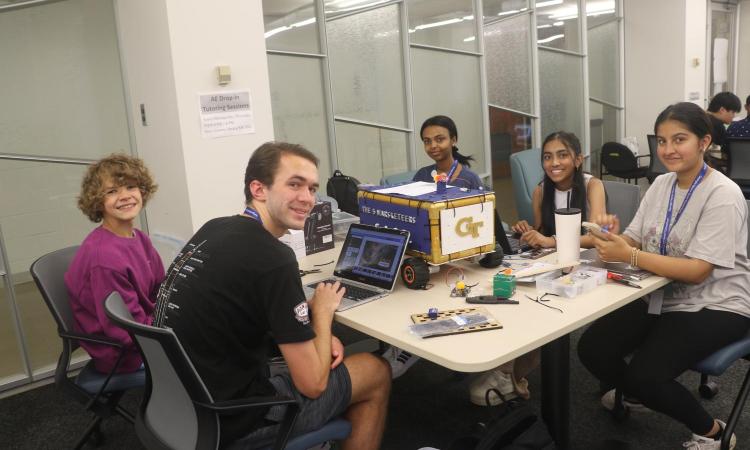
Georgia high school students learn through hands-on engineering projects. The Science, Technology, and Engineering Program (STEP) is a free summer camp open to Georgia students, and it all started in the basement of the Weber Building at Georgia Tech. Kelly Griendling, a determined research engineer at the time and now a lecturer in AE, dreamed of introducing high school students to aerospace engineering, and the Aerospace Systems Design Laboratory (ASDL) gave her goal wings to fly. Ten years later, the program has evolved and expanded to a second location in Albany, Georgia, fueling the pipeline internally and externally.
(text and background only visible when logged in)