
The student-operated CubeSat will test next-generation propulsion technology during a nine-month mission.

Left to right, front row: Morgan Gregg, Nina Otebele, Marian McDaniel, Megha Ayyaswamy, Glenn Lightsey. Back Row: Colin Quinn, Zuzu Jenni, Katya Tumanova, Ryan McKee, Mason Starr, Andrew Basin
EDITOR'S NOTE (Oct. 1):
The satellite made it to orbit. The Georgia Tech team made first contact on October 1 at 6:21 p.m. The first command sent was "Go Jackets!"
After NASA’s CubeSat reaches orbit in early October, it will spend nine months testing a new kind of propulsion system. And participating in the flight every step of the way will be a group of Georgia Tech students sitting in a mission control center in Atlanta.
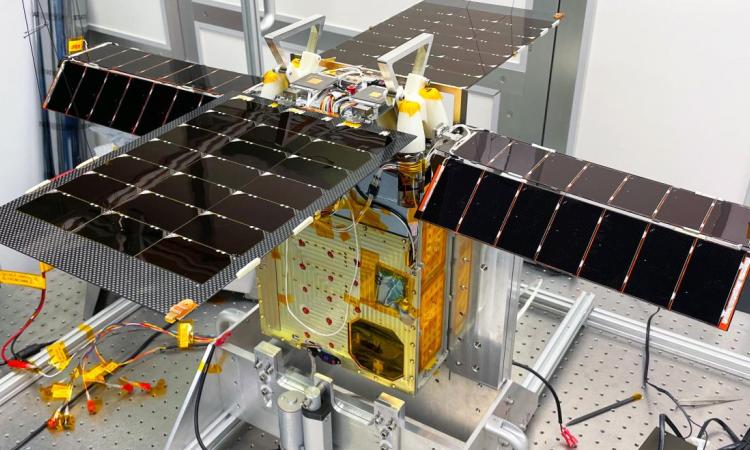
The mission is the culmination of three years of designing, building, and testing the small satellite, known as the ASCENT Propulsion Dual Mode spacecraft.
“What makes this mission especially meaningful is that our students have been involved every step of the way,” said Glenn Lightsey, professor and John W. Young Chair in the Daniel Guggenheim School of Aerospace Engineering. “Opportunities to take a spacecraft from concept to flight and perform mission operations are rare, and our students have earned that experience through an extraordinary amount of hard work and dedication."
The spacecraft is slated to lift off aboard a SpaceX Falcon 9 rocket from Vandenberg Space Force Base in California. It will operate in low Earth orbit at an altitude near 500 kilometers — higher than the International Space Station.

Professor Lightsey holding a 3D model of the Green Propulsion Dual Mode spacecraft outside of the Georgia Tech flight hardware lab.
The ASCENT Propulsion Dual Mode demonstration is designed to be a maneuverable CubeSat and prove that such capabilities can share the tight space alongside research payloads, unlocking complex orbital trajectories that were previously impractical for small spacecraft.

The integrated GPDM spacecraft being loaded into the CubeSat dispenser that will deploy it from the Falcon 9 rocket.

The integrated GPDM spacecraft ready for delivery from Georgia Tech to NASA.
Over a planned nine-month mission logging more than 1,000 hours of propulsion testing, student operators will staff the Space Systems Design Laboratory (SSDL) Mission Operations Center in daily shifts. The students completed flight-certification training in ground station operations, command sequencing, and telemetry analysis to prepare them to communicate with and steer the satellite. They will drive the spacecraft up and down a 5-kilometer altitude range, using an onboard star camera and GPS receiver to track its position while telemetry software monitors system health, voltage, and solar panel power.
The student controllers will work closely with Lightsey and NASA’s Marshall Space Flight Center throughout the mission. Several bring operations experience from NASA internships, including during the Artemis II mission.

Graduate students Ryan McKee, Andrew Basin, and Nina Otebele in mission control.
“You can't do a mission like this alone. Working with organizations such as NASA, along with operators from varied disciplines, is what makes this mission possible,” said master’s student Nina Otebele, one of the students who will work in mission control. “People from different backgrounds bring unique expertise that helps the team tackle a wide range of challenges.”

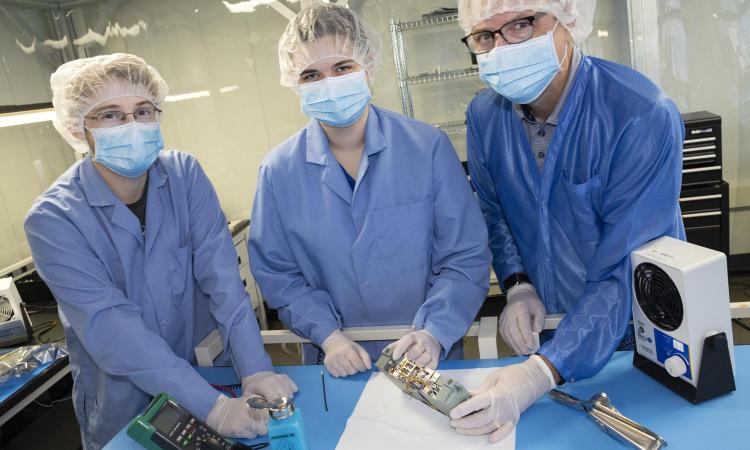
Graduate student Andrew Basin and Research Scientist Scott Gilliland working on the satellite.
Master’s student Ryan McKee will serve as the mission operations manager and is eager for the launch. He has been a part of the program for two years working in mission planning and spacecraft assembly, integration, and testing.
“I’m looking forward to first contact,” McKee said. “It’s an honor to work with and lead a team of exceptionally smart and capable people. This mission is helping me better understand what makes a good engineer and how to manage space operations. It’s been fun to figure out how students can meaningfully contribute to the mission.”
In collaboration with NASA and under the direction of Lightsey, the team is working to improve small satellite maneuverability with a new propulsion system that uses a single, shared fuel source to provide both high-thrust chemical energy for rapid maneuvers and lower-power but higher-efficiency electric thrust. The satellite runs on a less-toxic, environmentally friendly propellant called ASCENT that is safer and easier to handle than volatile hydrazine fuels.
“It's exciting to fly a satellite that is pushing the bounds of what's possible in propulsion technology,” said Andrew Basin, a Ph.D. student who has been with the project since day one. “This is the first vehicle of its kind to combine dual-mode propulsion, giving operators the flexibility to choose between a highly efficient system and a faster, more responsive one while in orbit.”
This is not the first time Georgia Tech aerospace engineering students have had the opportunity to work directly with NASA to fly a spacecraft from campus. In 2021, Georgia Tech students worked on the Lunar Flashlight CubeSat Mission.
"The hands-on spacecraft research conducted in the SSDL has become an integral part of the aerospace engineering experience at Georgia Tech,” Lightsey said. “I've had the privilege of watching three cohorts of students pour their energy, creativity, and determination into this mission. Seeing their work move from a design concept to a spacecraft ready for launch is a testament to their talent and the countless hours they've invested.”

Graduate student Ryan Mckee and Professor Lightsey in mission control.

Professor Lightsey and graduate students Morgan Gregg and Marian McDaniel.

Ph.D. student Mason Starr and graduate students Andrew Basin and Nina Otebele
Related Stories:
Lunar Flashlight Heads to the Moon to Search for Water
A small spacecraft assembled and tested at the Georgia Institute of Technology is on its way to the moon, where it will use lasers to search for surface water ice in lunar craters that are never warmed by light from the sun.
CubeSat on Artemis I Uses Georgia Tech Propulsion System
All eyes will be on the sky as NASA’s Artemis I mission launches from the Kennedy Space Center in Florida. Georgia Tech David Lewis Professor of Space Systems Technology, Glenn Lightsey, and his team developed the propulsion system for the small satellite BioSentinel that will be onboard the Space Launch System (SLS) megarocket.